Men on Men by George Stambolian (ed)
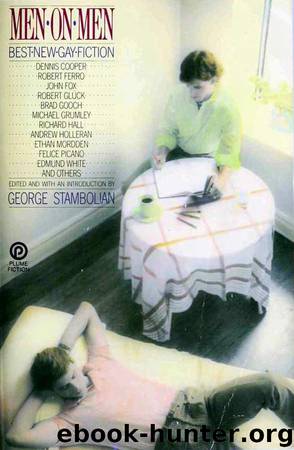
Author:George Stambolian (ed) [Stambolian, George]
Language: eng
Format: epub
Tags: Homosexuality, Male—Fiction., American fiction—20th century., American fiction—Men authors., Men—Fiction.
Publisher: Plume Books, New York
Published: 1986-11-15T05:00:00+00:00
HARDHATS
Ethan Mordden
AS THE SON OF A BUILDER I spent high school spring vacations on various construction sites in and around New York. It was my first experience of absolutely impenetrable men, not only tough but emotionally invulnerable. Ironworkers—the men who lay a building’s steel skeleton—are a class unto themselves. Passing someone while carrying a load of material, they don’t say, “Excuse me,” but “Get the fuck out of my way”—yet they say it in the tone Edmund White would use for “Excuse me.” Challenged by their own kind, they can be vivacious; challenged by an alien, they are fast and lethal.
It’s an intolerant class, racist, sexist, fascistic yet patriotic about a democracy; almost the only place to see the flag these days, besides outside federal agencies, is on the trucks serving construction sites. (They also mount a flag atop each building as the last girder is placed, as if they had climbed rather than built a mountain.) Ironworkers are not merely proletarians; they are proletarians without the barest internal contradictions, without ambition, pull, or PR. They are the cowboys of the city, skilled workers who are also vagabonds with nothing to lose. They have one of the toughest jobs in America: exhausting, permanently subject to layoff, and extremely dangerous. The raising of office towers routinely claims a life or two. At least bridgework is worse. The Whitestone Bridge was regarded as a life-sparing marvel because only thirty-five men were lost on it.
There is one major contradiction in the ironworker, his endless enthusiasm for street courtship. What other set of Don Juans ever went out so unromantically styled—casually groomed, tactlessly dressed, unimaginatively verbal? “Got a cookie for me, honey?” they will utter as a woman strolls by. Of course she ignores them; it wouldn’t get you far in the Ramrod, either. Sometimes a group of them will clap and whistle for a ten, and I’ve seen women with a sporty sense of humor wave in acknowledgment. But there the rapport ends.
So why do they keep at it? Has one of them ever—in the entire history of architecture from Stonehenge to the present— made a single woman on the street? There are the occasional groupies, true: a few days ago I saw a young woman with the intense air of the bimbo about her waiting outside the site next to my apartment building just before quitting time with a camera in her hands. But this is the kind of woman these men have access to anyway, not least in the neighborhood bars where they cruise for a “hit.” The ladies of fashion who freeze out these lunch-break inquiries are a race of person these men will never contact. After all, women like being met, not picked up, especially not on the street.
One of the workers next door eats his lunch sitting on the sidewalk in front of my building. Men he discounts or glares at; women he violates in a grin. The pretty ones get a hello. I was heading home from
Download
This site does not store any files on its server. We only index and link to content provided by other sites. Please contact the content providers to delete copyright contents if any and email us, we'll remove relevant links or contents immediately.
| Anthologies | Short Stories |
The Tidewater Tales by John Barth(12706)
Kathy Andrews Collection by Kathy Andrews(11980)
Tell Tale: Stories by Jeffrey Archer(9083)
This Is How You Lose Her by Junot Diaz(6960)
The Mistress Wife by Lynne Graham(6531)
The Last Wish (The Witcher Book 1) by Andrzej Sapkowski(5518)
Dancing After Hours by Andre Dubus(5306)
The Sympathizer by Viet Thanh Nguyen(4446)
Be in a Treehouse by Pete Nelson(4096)
The Secret Wife by Lynne Graham(3948)
Maps In A Mirror by Orson Scott Card(3944)
Tangled by Emma Chase(3799)
Ficciones by Jorge Luis Borges(3696)
The House on Mango Street by Sandra Cisneros(3512)
A Knight of the Seven Kingdoms by George R R Martin(3443)
Girls Who Bite by Delilah Devlin(3294)
You Lost Him at Hello by Jess McCann(3112)
MatchUp by Lee Child(2907)
Once Upon a Wedding by Kait Nolan(2822)
